

Students, never saviours.
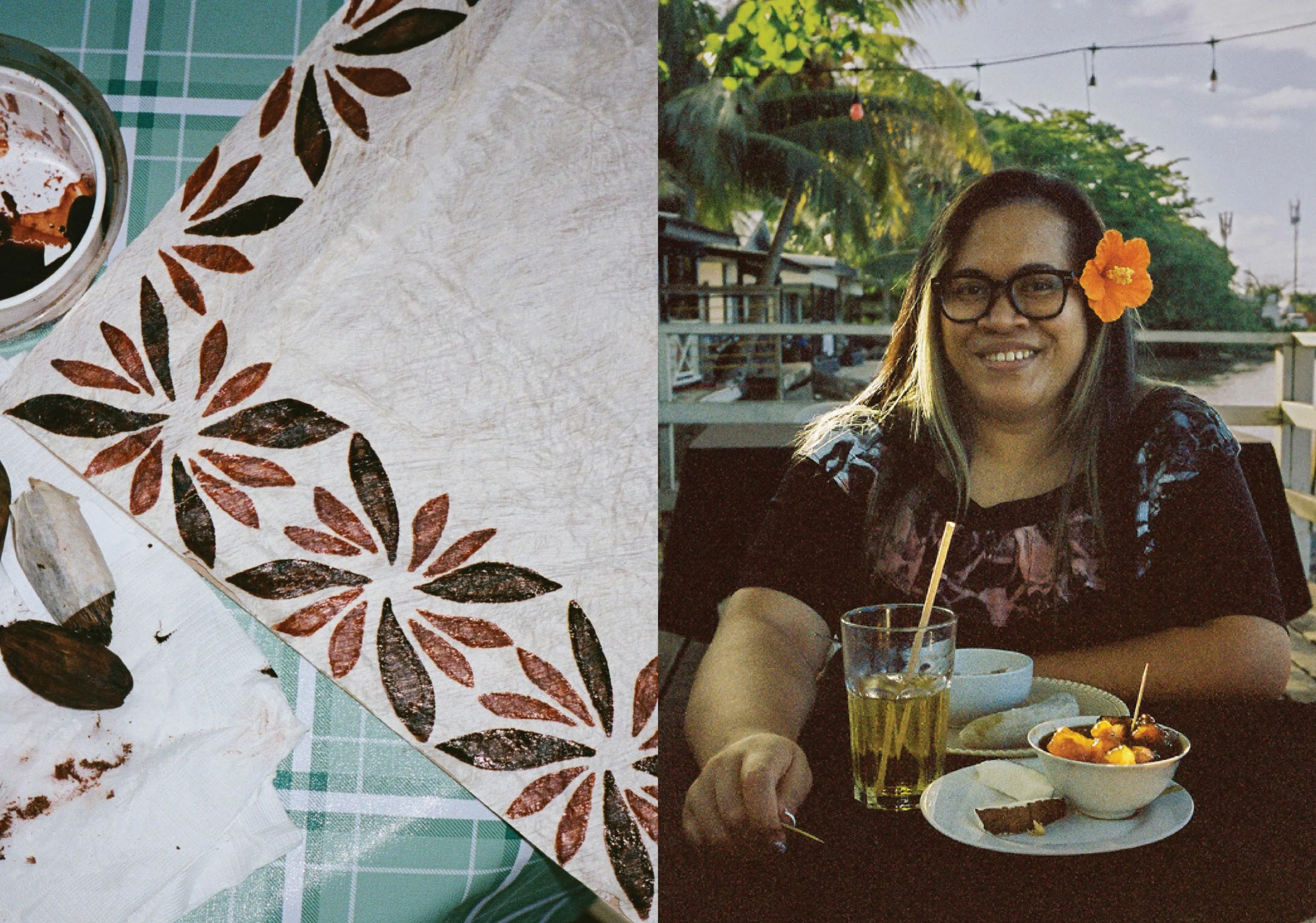
Photo / Marianna Jakubiková
There is a strange thing that happens when you work in the Pacific from somewhere else. You can start to think that your value is in what you can bring with you.
A different way of doing things. Different creative skills. Different networks. Different access to markets. All of which can be useful, and all of which we have brought into our work at Susu & Meli.
But the longer we have spent working with people in Samoa, the more we have questioned the idea that what is needed is something to be brought in at all.
We think about Tusi a lot when we think about this.
We met Tusi through our relationship with the Salu family, and over the past two years she has become one of the people we have learnt the most from.
She is 28. She lectures at the University of the South Pacific, teaching agriculture, including farming practices and livestock management. She lives in Upolu, while her family’s siapo work continues in Savai’i.
Alongside her academic career, she manages the digital and commercial side of the family business.
She looks after the social media, the digital marketplace, marketing, customer enquiries, customised orders and souvenirs. She is the main point of contact between the family in Savai’i making the siapo and the people buying it in other places.
She has been part of the business since primary school. We find that detail particularly interesting because it completely changes the way we think about what it means to ‘preserve’ culture.
Tusi isn't trying to preserve something she has only just discovered. She grew up in it.
She learnt to make siapo with her sisters. She knows the history. She knows the work involved. She knows the women who carried the practice before her. Now she is using the education and skills she has developed since then to help the family business grow.
The practice has moved with her.
From Savai’i to Upolu. From childhood to university. From learning how to make siapo to learning how to market it. From the women who made it before her to the generation now figuring out what it looks like to carry it forward.
And that, to us, is a much more interesting story than the idea of culture being something that needs to be saved.
Because saved by who?
And from what?
The more people we meet through our work, the harder it becomes to make the argument that our Pacific Islands are sitting there waiting for someone outside of it to come along and work out what it needs.
There are people already doing the work. They just might not be doing it in the way we expect.
They are lecturers and business owners and artists and farmers and daughters. They are building businesses, teaching their children, adapting old practices to new markets and working out how tradition fits into lives that also include university degrees, social media, full-time jobs and everything else that comes with being a person in 2026.
Tusi is a good example of that.
So is her family.
And this is where our own position has become clearer.
We don't go into these relationships thinking we have nothing to offer. We do.
Susu & Meli exists because we have spent years learning how to build brands, tell stories, develop creative ideas and connect businesses with people. There is value in that, and we believe there is value in bringing those skills into Pacific businesses.
But there is a difference between bringing something to the table and assuming you built the table.
That distinction has become important to us.
Our relationship with the Salu family isn't a case of us coming in to tell them how to tell their story. They already know their story.
It isn't about teaching them how to build a business. They have been building one for years.
It is about figuring out what our skills can do alongside what they already know.
That is what makes us business partners.
And, honestly, students.
There are things you can only learn by being around people. You can read about siapo. You can understand the process. You can learn about its history.
But sitting with a family who has actually carried the practice across generations is different. You start noticing the things that don't make it into the case study.
The way knowledge moves between sisters.
The way a daughter can have a career of her own and still have a place within the family business.
The way a practice can change without becoming less itself.
The way people living in Samoa are already thinking about the future of their culture without needing someone else to arrive and tell them it has one.
We think this is also why the relationship with Tusi has felt familiar to us.
We are all daughters.
Our lives are different. Our experiences of Samoa are different. We have lived in different places and have different relationships with our culture.
But there are certain things you don't need to explain.
You understand what it means to care about your family.
To want to make them proud.
To feel responsible for something that existed before you and will hopefully exist after you.
To have your own ambitions while still knowing that you are part of something bigger than yourself.
That common ground has probably taught us more than trying to define exactly what makes someone ‘Pacific’ enough to participate in Pacific work ever could.
We really don't think there is one version of what that looks like.
There are people living in the islands who are carrying culture forward.
There are people living elsewhere who are doing the same thing in their own way.
There are people like us who have skills and experience that can be useful to businesses and communities we have relationships with.
And there are people who know things we never will.
None of those positions need to compete.
Maybe the more useful question is simply — what is my role here?
For us, sometimes it is creative direction.
Sometimes it is strategy.
Sometimes it is making an introduction or opening up a new possibility.
And sometimes it is listening to Tusi explain something we thought we understood and realising we had more to learn.
We don't think being a student makes the work less valuable.
If anything, it has made our partnerships better.
There is a certain freedom in knowing you don't have to be the person with the answer.
You just have to know what you know, know what you don't, and respect the people who know more than you do.
The longer we work this way, the less interested we are in the idea of coming back to the Pacific with something to give.
We'd rather come with something to share.
There is a difference.
One assumes the knowledge is missing. The other assumes it is already there.
And when we look at people like Tusi, at the work her family is doing in Savai’i, at the businesses being built and the knowledge being carried from one generation to the next, it is pretty difficult to argue otherwise.